AI voice agents are transforming how businesses communicate with customers, employees, and partners. With AI-powered customer service, organizations can offer a seamless, natural interaction where people no longer wait on hold, navigate endless menus, or repeat information to multiple agents. By leveraging business growth using AI in call centers, companies can improve operational efficiency, enhance customer loyalty, and provide instant, intelligent support 24/7.
In this guide, you will discover what an AI voice agent is, how it works, and the real-world benefits it delivers for your organization. Whether you’re exploring AI-driven contact center solutions - FlashMob Computing or learning about supercomputer-powered customer service platforms, AI voice agents are a critical part of modern business communication. For insights into marketing strategies that enhance customer experience or practical AI tools for scaling operations, you can access valuable resources. Additionally, financial and operational insights for businesses help organizations make smarter decisions when integrating AI voice technology.
Top 10 AI Contact Center Solutions for AI Voice Agent Integration
Choosing the right AI contact center solution is crucial for businesses looking to enhance customer engagement, improve efficiency, and deliver intelligent support. AI voice agents are at the core of these platforms, enabling natural, instant, and accurate interactions with customers. Here’s a look at the top 10 AI contact center solutions in the market.
1. Bright Pattern – AI Contact Center Solutions
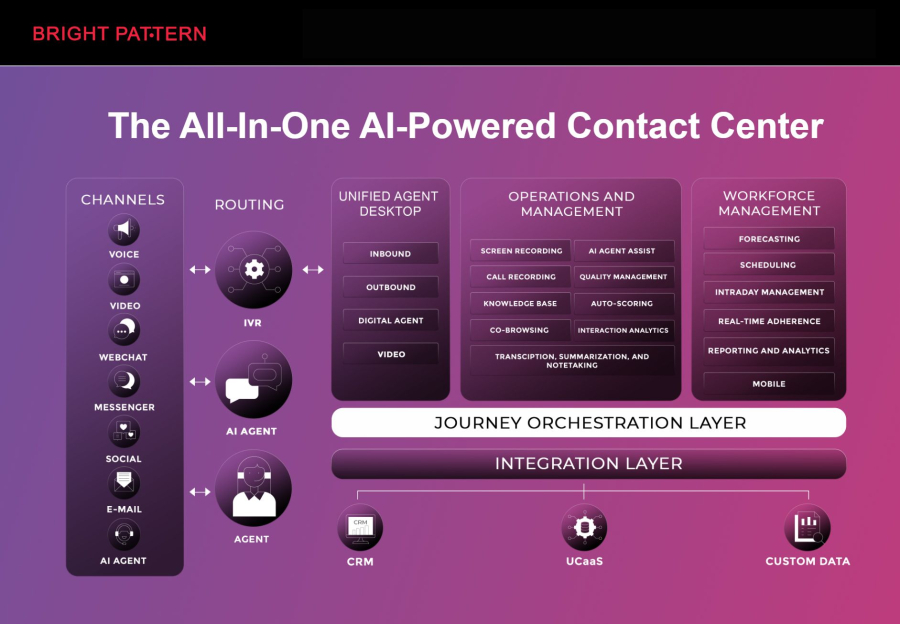
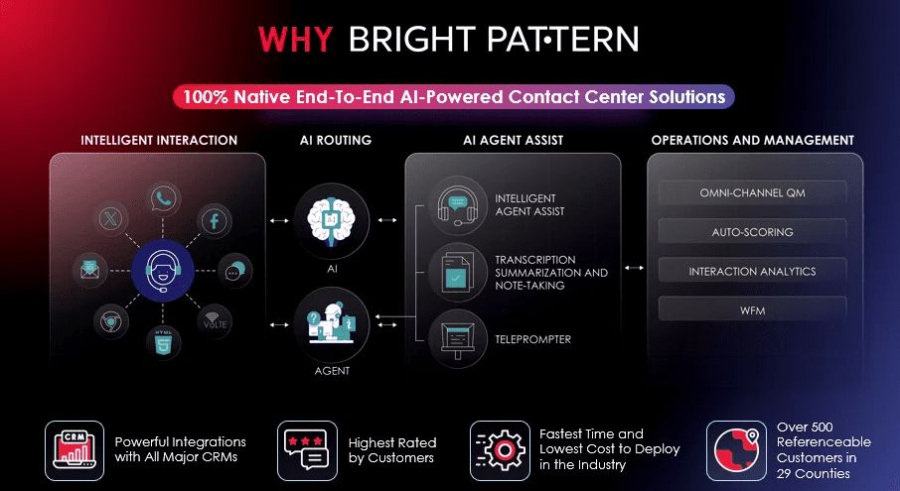
Bright Pattern leads the market with its comprehensive AI contact center platform designed for businesses of all sizes. It offers seamless integration of AI voice agents, enabling smart, automated customer interactions across phone, chat, email, and social media.
Key features include:
- Intelligent routing of calls to the right agent based on AI analysis
- AI voice agents that understand natural language and provide instant assistance
- Omnichannel support to unify customer interactions across multiple platforms
- Analytics and reporting to optimize call center performance
- Scalable solutions suitable for small teams to large enterprises
Bright Pattern’s platform not only streamlines operations but also helps improve customer satisfaction and reduce operational costs, making it a top choice for organizations seeking advanced AI contact center solutions.
2. Five9 – Cloud Contact Center Solutions
Five9 provides cloud-based contact center solutions with AI-driven tools that support intelligent virtual agents, predictive dialing, and workforce optimization. Their AI voice agents help improve call resolution rates and enhance the overall customer experience.
3. Genesys – AI-Powered Customer Service
Genesys delivers AI contact center software that combines natural language processing, automation, and analytics. Their AI voice agents can handle routine inquiries and assist human agents with real-time insights, improving service efficiency.
4. Talkdesk – Intelligent Call Center Platform
Talkdesk offers AI-powered virtual agents and omnichannel contact center solutions. AI voice agents handle common customer questions, while advanced analytics help managers make data-driven decisions.
5. NICE inContact – Cloud Contact Center Solutions
NICE inContact provides an AI contact center platform that integrates AI voice agents with workforce engagement tools, real-time analytics, and omnichannel routing to enhance customer service.
6. 8x8 – AI Contact Center Services
8x8 delivers a cloud contact center platform with AI voice agents that can manage multiple communication channels, streamline call workflows, and improve customer satisfaction.
7. Avaya – Unified Contact Center Solutions
Avaya combines AI and cloud technologies to support intelligent virtual agents, automated call handling, and analytics. AI voice agents reduce wait times and assist human agents with accurate information.
8. RingCentral – AI-Powered Communication Platform
RingCentral’s AI contact center integrates virtual agents, speech recognition, and analytics to provide efficient customer support and enhance overall operational performance.
9. Zendesk – AI Customer Engagement
Zendesk integrates AI voice agents into its customer service platform to provide automated responses, triage inquiries, and improve agent productivity across multiple channels.
10. Cisco – Intelligent Contact Center Solutions
Cisco provides AI-enabled contact center solutions with virtual agents, predictive routing, and unified communications to streamline customer interactions and boost operational efficiency.
What Is an AI Voice Agent?
An AI voice agent is a software-powered assistant that uses artificial intelligence to understand spoken language, process it, and respond with natural-sounding speech. It can handle phone calls or voice interactions in real time, much like a human agent, but with the scalability and consistency of software.
Unlike traditional phone menus or simple chatbots, a modern AI voice agent can:
- Understand natural speechrather than just fixed phrases or number-based menus.
- Detect context and intentto figure out what the caller really wants to achieve.
- Access data and systemssuch as CRMs, scheduling tools, or order databases to take real actions.
- Speak in a human-like, branded voicethat feels conversational and empathetic.
- Learn and improveover time from new interactions and feedback.
In short, an AI voice agent is a virtual agent that can actually do the work: answering questions, routing calls, authenticating users, taking orders, booking appointments, and more.
How AI Voice Agents Work
AI voice agents combine several AI technologies behind the scenes to deliver smooth, real-time conversations. While the experience feels simple for the caller, the pipeline is quite powerful.
1. Speech Recognition (ASR)
First, the agent must convert the caller's spoken words into text. This is handled byautomatic speech recognition, or ASR. Modern ASR models can:
- Handle different accents and speaking speeds.
- Adapt to domain-specific vocabulary, such as product names or technical terms.
- Work in noisy environments with background sounds.
2. Natural Language Understanding (NLU)
Once the speech is converted to text,natural language understanding(NLU) identifies the caller's intent (what they want to do) and key details (such as dates, order numbers, or locations). For example, from the phrase:
I want to reschedule my appointment from Friday to next Tuesday afternoon.
The NLU layer might extract:
- Intent: Reschedule appointment
- Original date: Friday
- New date: Next Tuesday
- Preferred time: Afternoon
3. Dialog Management
Thedialog managerdecides how the agent should respond based on:
- The current intent and extracted details.
- Business rules and workflows, such as authentication requirements.
- The history of the conversation so far.
This component controls the flow of the interaction: asking clarifying questions, confirming details, handling errors, and moving toward resolution.
4. Backend Integrations
To be truly useful, the AI voice agent needs to connect to your existing systems. Depending on the use case, this can include:
- Customer relationship management platforms for retrieving customer profiles.
- Order management tools for checking order status or processing returns.
- Appointment or calendar systems for scheduling and rescheduling.
- Knowledge bases for product information or troubleshooting steps.
- Authentication services for secure identity verification.
Through these integrations, the agent can go beyond answering basic FAQs and perform real, high-value tasks on behalf of the caller.
5. Natural Language Generation (NLG)
Next, the system generates an appropriate text response. This can be:
- A simple template such as We have updated your shipping address.
- A dynamic answer assembled from multiple data sources.
- A fully generated, conversational response that adapts to the caller's tone and context.
6. Text-to-Speech (TTS)
Finally, the response text is converted back to spoken audio usingtext-to-speech(TTS). High-quality TTS engines can:
- Produce natural-sounding voices with appropriate pacing and emphasis.
- Reflect your brand by using a consistent speaking style.
- Support multiple languages and dialects.
All of this happens in fractions of a second, giving callers the experience of a smooth, real-time conversation.
AI Voice Agents vs. Traditional IVR Systems
Many people think of phone automation and remember rigid, frustrating interactive voice response menus. AI voice agents are the next generation of this technology, eliminating many pain points.
|
Feature |
Traditional IVR |
AI Voice Agent |
|
Interaction style |
Menu-based, press 1 for... |
Free-form, natural conversation |
|
Flexibility |
Rigid paths, hard-coded flows |
Dynamic, adapts to caller intent |
|
Understanding |
Limited keyword or digit input |
Understands varied phrases and questions |
|
Resolution capability |
Often routes rather than resolves |
Resolves many tasks end-to-end |
|
Maintenance |
Time-consuming to update |
Can learn and improve over time |
|
Customer perception |
Frequently frustrating |
Closer to speaking with a human |
This shift from menu navigation to true conversation is what makes AI voice agents so powerful for modern customer experience.
Key Benefits of AI Voice Agents
When implemented thoughtfully, AI voice agents deliver value across customer experience, operations, and business growth.
1. 24/7 Availability Without Extra Headcount
Customers expect support at any time. An AI voice agent never sleeps, allowing you to:
- Offer round-the-clock assistance, even across time zones.
- Handle after-hours and weekend spikes without staffing challenges.
- Reduce wait times during peak hours by sharing the load with human teams.
2. Shorter Wait Times and Faster Resolution
AI voice agents can answer calls immediately, without putting callers on hold. They can:
- Resolve common questions in seconds.
- Gather key information automatically before transferring to a human.
- Use caller history to skip repetitive questions.
The result is a smoother, faster experience that feels respectful of the caller's time.
3. Consistent, High-Quality Service
Human agents can have off days; AI voice agents deliver consistency. They:
- Follow your best-practice scripts and workflows every time.
- Give accurate, up-to-date answers from a single source of truth.
- Apply policies and compliance rules uniformly across all interactions.
4. Lower Operational Costs
By automatically handling routine and repetitive calls, AI voice agents:
- Reduce the cost per contact.
- Allow human teams to focus on complex, high-value interactions.
- Decrease training requirements for simple tasks.
Over time, many organizations see that the combination of AI and human support allows them to grow without a matching increase in staffing costs.
5. Scalable During Surges
Business does not always move at a steady pace. Product launches, seasonal peaks, or unexpected events can create sudden volume spikes. AI voice agents make it easier to:
- Absorb large call volumes without degrading service.
- Maintain stable customer experience even when demand jumps.
- Scale up or down quickly without long hiring cycles.
6. Rich Insights From Every Conversation
Because AI voice agents are digital, every interaction can become a source of insight. You can analyze:
- Common questions and recurring pain points.
- Reasons for calls and trends over time.
- Language patterns that correlate with satisfaction or churn.
These insights support smarter product decisions, clearer communication, and continuous CX improvements.
High-Impact Use Cases for AI Voice Agents
AI voice agents can add value in many industries and departments. Here are some high-impact examples.
Customer Support and Service Desks
- Answering frequently asked questions.
- Providing account balance, order status, or delivery updates.
- Guiding through simple troubleshooting steps.
- Resetting passwords and handling basic account changes with verification.
Sales and Lead Qualification
- Responding to inbound inquiries from campaigns or ads.
- Qualifying leads by asking key questions and capturing intent.
- Scheduling callbacks or meetings with sales reps.
- Following up on quotes or abandoned orders.
Appointment Booking and Scheduling
- Booking, rescheduling, or canceling appointments.
- Sending confirmations and reminders via integrated channels.
- Managing waitlists and offering earlier time slots when they open.
Banking and Financial Services
- Checking balances and recent transactions.
- Answering questions about fees, rates, and product features.
- Authenticating customers before transferring to a specialist.
Healthcare and Wellness
- Helping patients schedule or change appointments.
- Answering questions about clinic hours, locations, and preparation steps.
- Providing general guidance based on approved content and protocols.
Travel, Hospitality, and Logistics
- Sharing booking details, check-in times, and gate information.
- Supporting simple changes, such as updating contact information.
- Providing delivery tracking and shipment updates.
These are just a few examples. Any workflow that is structured, repeatable, and currently handled by phone is a strong candidate for AI voice automation.
Designing an Effective AI Voice Agent Experience
Success with AI voice agents is not only about the technology. It also depends on thoughtful experience design and alignment with your brand.
1. Start With Clear Goals
Define what success looks like before you start. For example, you might aim to:
- Reduce average handle time for specific call types.
- Increase first-call resolution for common issues.
- Automate a percentage of order status or booking calls.
Clear goals help you focus your initial use cases and measure impact accurately.
2. Automate the Right Tasks First
Not every call type is ideal for automation from day one. To build momentum, prioritize:
- High-volume, low-complexity interactions.
- Tasks with clear, structured workflows.
- Scenarios where quicker responses create clear value.
As your AI voice agent proves itself, you can gradually expand to more complex workflows.
3. Design Conversations, Not Menus
Think in terms of conversations instead of rigid trees. Focus on:
- How callers naturally phrase their questions.
- What information they need to feel heard and supported.
- Graceful ways to handle misunderstandings or incomplete answers.
Well-designed dialog flows keep interactions efficient while still feeling human.
4. Seamless Handoffs to Human Agents
AI voice agents work best in partnership with people. Ensure that:
- Callers can easily reach a human when needed.
- Context, such as previous questions and captured data, is passed to the agent.
- Agents see a clear summary so customers do not have to repeat themselves.
This hybrid model delivers the best of both worlds: automation for speed and human empathy for complex situations.
5. Maintain Your Brand Voice
Your AI voice agent should sound like an extension of your brand. Consider:
- The tone you want to project, such as friendly, professional, or reassuring.
- Consistent phrases and greetings across all channels.
- How the agent handles apologies, delays, or errors in a way that reflects your values.
Measuring Success and ROI
To capture the full value of an AI voice agent, track metrics that connect directly to your goals.
Operational Metrics
- Containment rateThe percentage of calls fully handled by the AI without human intervention.
- Average handle timeTime from start to resolution, both for AI-only calls and hybrid flows.
- Call deflectionReduction in calls handled by human agents for targeted use cases.
Customer Experience Metrics
- Customer satisfactionAfter-call surveys or ratings.
- Net promoter scoreOver time, as automation improves consistency and speed.
- First-call resolutionThe share of issues solved on the first interaction.
Financial Impact
- Cost per contactCompare before and after automation.
- Staffing efficiencyAbility to handle more volume with the same or smaller team.
- Revenue influenceFor sales use cases, track conversion, upsell, or retention improvements.
By linking these metrics to your original goals, you can build a clear business case and continually refine your AI voice strategy.
Best Practices for Deploying AI Voice Agents
A thoughtful deployment approach accelerates results and minimizes friction.
1. Involve Stakeholders Early
Bring together leaders from customer service, operations, IT, compliance, and marketing to align on:
- Use cases and priorities.
- Brand voice and conversational guidelines.
- Integration requirements and data security needs.
2. Pilot, Learn, and Iterate
Start with a focused pilot rather than a big bang rollout. During the pilot:
- Monitor real conversations for misunderstandings or friction.
- Refine prompts, responses, and routing logic.
- Collect feedback from both customers and human agents.
This iterative approach builds confidence and ensures the agent reflects real-world needs.
3. Prioritize Transparency and Trust
Callers should know when they are speaking to an AI system. Make it clear at the start of the interaction, and emphasize that:
- They can reach a human if they prefer or if the issue is complex.
- Their data is handled securely and according to your policies.
Transparent communication builds trust and reduces confusion.
4. Keep Content and Integrations Up to Date
Your AI voice agent is only as accurate as its data. Establish processes to:
- Update FAQs, scripts, and knowledge bases as policies change.
- Review integration points when backend systems are upgraded.
- Continuously test high-impact flows for accuracy and speed.
The Future of AI Voice Agents
AI voice technology is evolving quickly. In the near future, you can expect AI voice agents to become even more:
- Context-awareRemembering preferences and prior interactions across channels.
- Emotionally intelligentAdapting responses based on tone, pace, or sentiment in the caller's voice.
- MultimodalCoordinating voice, text, and visual information across devices.
- CollaborativeWorking side by side with human agents, suggesting answers or next best actions in real time.
Organizations that invest now gain a powerful foundation for these future capabilities, while already improving experience and efficiency today.
Conclusion: Turning Conversations Into a Competitive Advantage
AI voice agents are reshaping how businesses communicate. By combining natural, human-like conversations with the speed and scale of AI, they turn every call into an opportunity to deliver fast, reliable, and memorable service.
From reducing wait times and support costs to unlocking 24/7 availability and richer insights, AI voice agents help you transform your contact center from a cost center into a strategic advantage. With clear goals, thoughtful design, and continuous improvement, they can quickly become one of the most impactful tools in your customer experience toolkit.
The next wave of customer expectations is already here. An AI voice agent gives you a practical, powerful way to meet those expectations and stay ahead.
